Chu Wang Pianjun
Demi-Gods and Semi-DevilsThe Prince of Chu’s rebels are the armed force raised in the Liao Empire’s civil war by Yelu Nie-lugu, the Prince of Chu and Lord of the Southern Chancellery, against Emperor Yelu Hongji. Their rebellion turns an old succession compromise into an immediate contest for power: it occupies the capital, takes members of the imperial family hostage, and invokes Yelu Zhongyuan’s claim to the throne. Yet the revolt’s military advantage and official proclamation cannot settle the question of legitimacy. It is ultimately broken by Xiao Feng, whose intervention leads the rebels to surrender and brings him, unwillingly, into high Liao office.
Origins and Claims to Authority
The rebellion grows from the settlement made after the death of Yelu Longxu, remembered as the Holy Emperor. His elder son Yelu Zongzhen was designated to succeed him, although the empress favored her younger son, Yelu Zhongyuan, and schemed to put him on the throne. Zhongyuan did not accept that opportunity: he disclosed their mother’s plan to his brother, who then succeeded as emperor. In gratitude, Zongzhen gave Zhongyuan the rank of royal emperor brother and placed him next in the line of succession.
That succession did not pass to Zhongyuan when Yelu Zongzhen died. Instead, the throne went to Zongzhen’s son, Yelu Hongji. Hongji later sought to compensate his uncle by granting him the title of royal emperor uncle, placing him next in the succession again, and making him supreme commander of the army. He also exempted him from kneeling at court and granted him honors and special privileges. Zhongyuan thus held an unusually powerful position while remaining outside the throne; the old accommodation helped preserve the dynasty, but also left a powerful alternative claimant within the imperial family.
Yelu Nie-lugu, Zhongyuan’s son, held the Southern Chancellery and controlled its military affairs as Lord of the Southern Chancellery. When Hongji was away on a hunting expedition, Nie-lugu staged the rebellion and occupied the main palace. The emperor’s wife and other members of the imperial household, along with more than a hundred officials and their families, were taken captive. Zhongyuan had previously been trusted with military authority and, according to the account, had himself once declined the throne in favor of his brother. Hongji therefore faces a revolt in which his uncle’s established standing lends force to his son’s challenge, even though the account distinguishes Nie-lugu’s ambition from Zhongyuan’s earlier loyalty.
Mobilization and the Rival Edict
The crisis reaches Hongji through a system of relayed bugle calls. When the signal arrives, the partying officers fall silent, and Hongji drinks from his golden cup before ordering the army to break camp and return to the capital. Orders travel down the command structure from one officer to the next, while the troops pack and march in disciplined formations. After three days on the road, a scout reports that the Lord of the Southern Chancellery has seized the palace and captured the empress dowager, empress, princes, princesses, officials, and their families.
A second report makes the revolt’s political claim explicit: Nie-lugu has declared his father emperor. The edict calls Hongji a false ruler who usurped the throne and presents Zhongyuan as the legitimate sovereign. Hongji burns the document, but recognizes the danger in its argument. Zhongyuan’s position as supreme commander gives him authority over a force said to number 800,000, while Hongji has only about 100,000 troops with him. The rebels’ proclamation is therefore not merely a battlefield challenge: it attempts to make imperial allegiance itself appear uncertain.
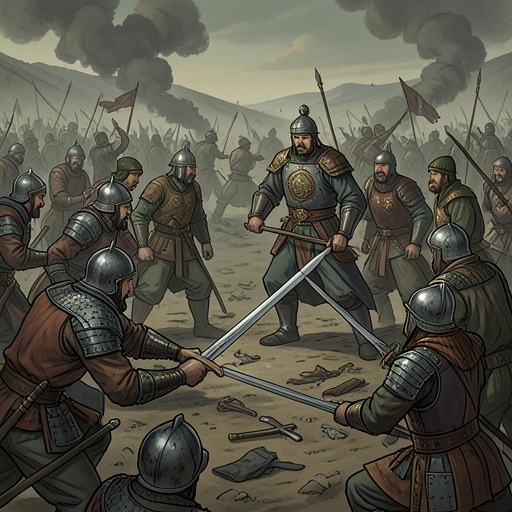
Hongji’s army is ordered to meet the advancing force, reported at 500,000 men. Hongji promises promotion and substantial rewards after the crisis, dons golden armor and a helmet, and personally leads three troops. His appearance at the head of the army raises the soldiers’ courage, and they cheer and pledge to fight to the death. Xiao Feng rides beside him as a personal guard. The scene places the emperor’s personal authority against the rebels’ numerical advantage, while making troop morale a decisive part of the contest.
At the confrontation, the rebels send five horsemen forward with a sheepskin copy of Zhongyuan’s edict. They recite its accusations against Hongji and urge Liao soldiers and officials to return to the capital and pledge allegiance to the new emperor, offering promotion by three ranks. Arrows are fired at the messengers, but their companions protect them with shields until the reading is complete. The proclamation unsettles Hongji’s officials; his side responds by sending out professional cursers to denounce the rebels. The exchange makes the conflict’s struggle over loyalty visible: both armies rely not only on force, but on public claims about who has the rightful authority to command.
Hostages, Defeat, and Surrender
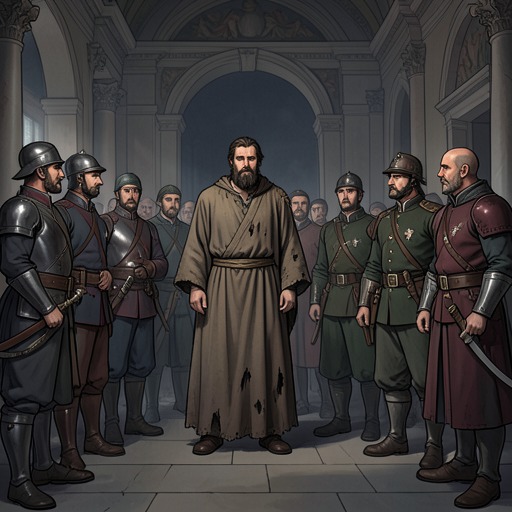
The rebels’ hold over the imperial household does not make Hongji yield. When women among the captives are brought forward and cry out, the confrontation escalates; the empress, rather than renouncing her husband’s cause, affirms her loyalty to him. The Prince of Chu then orders the empress dowager and empress detained on carts and calls for the families of the opposing soldiers to be brought forward. More than 200,000 people are said to be connected to the soldiers’ households, though only 30,000 captives are brought into view, and some have been arrested by mistake. The mass of families, including the elderly and children, exposes the human cost of a military system that kept soldiers’ relatives in the capital to secure the army’s loyalty and restrain revolt.
The confrontation reaches its turning point when Xiao Feng kills the Prince of Chu and captures Yelu Zhongyuan. Zhongyuan acknowledges that his son’s ambition brought about the disaster and agrees to address the rebel troops. Seated securely on a horse and announced by Xiao Feng, he tells them that the Prince of Chu has caused the calamity, that the emperor will pardon the rebels, and that they should lay down their weapons and seek forgiveness. With their leader dead and Zhongyuan speaking against the rebellion, the soldiers lose their reason to continue. Weapons fall, and the rebellion is effectively ended without the captured forces having to be defeated one by one.
Aftermath and Political Significance
Xiao Feng brings Zhongyuan to Hongji, who is overwhelmed with relief and calls Xiao Feng his brother. Asked for his judgment, Xiao Feng urges Hongji to pardon his uncle, arguing that mercy will steady the troops. Hongji agrees and appoints Xiao Feng Prince of Chu and Lord of the Southern Chancellery, ordering him to lead the rebel army back to the capital. The title once held by the rebellion’s leader is thus transferred to the man who helped defeat it. Xiao Feng had acted to save his sworn brother, not to seek office, and asks Hongji to withdraw the appointment; Hongji insists on the honor and even says he would surrender the throne rather than have Xiao Feng refuse him.
The appointment gives Xiao Feng formal command over a state apparatus whose power reaches far beyond the battlefield. After a month occupied by officials, tribal chiefs, and foreign envoys seeking favor, Hongji tells him to base himself in Nanjing and prepare to conquer the Great Song when circumstances permit. Xiao Feng is troubled by the order: although he is a Liao subject, he grew up in the south, and he does not want to lead a campaign against the Song. He accepts the post for the sake of his bond with Hongji, intending to wait in Nanjing and later seek resignation. The rebellion’s consequences therefore extend beyond its defeat: rescuing the emperor draws Xiao Feng into a political role whose duties conflict with the loyalties formed by his life and sworn brotherhood.
The crisis is also framed by the strategic geography of Liao’s conflict with the Song. The account identifies the sixteen prefectures ceded to Liao after Shi Jingtang sought its support, and explains that their positions gave Liao a military advantage in repeated wars with the Song. Hongji’s ambition to conquer south is shaped by that inherited territorial advantage, while Xiao Feng’s unease reflects the human and political cost concealed by the language of imperial opportunity. The revolt is thus more than a failed bid for the throne: it shows how succession arrangements, control of military offices, family hostages, and frontier strategy constrain the choices of rulers and the people drawn into their wars.